
How to Choose a Pillow for Side Sleeping, Back Sleeping and Neck Support
Oct 31, 2026
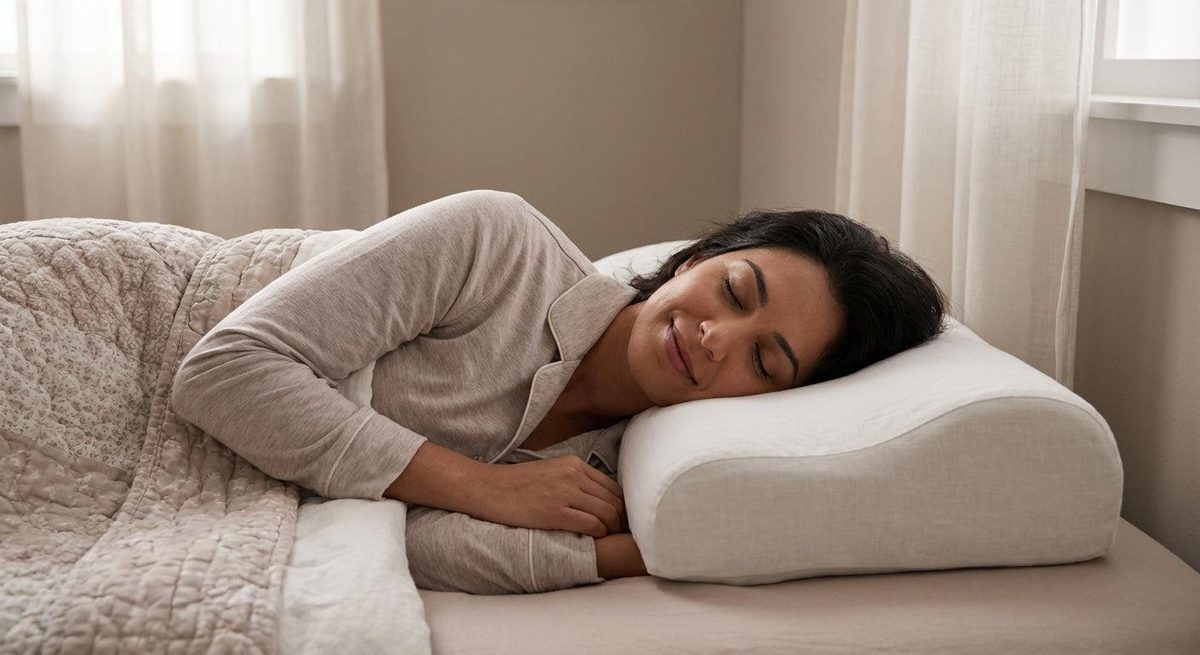
Choosing a pillow is mostly a matter of matching three things: the way you sleep, the height and firmness that keep your neck comfortable, and the materials and policies you can live with. There is no single best pillow, and research does not give a universal answer. This guide takes you through side, back, stomach, and combination sleeping, then through height, firmness, materials, care, replacement, and the questions to ask before buying.
Affiliate disclosure: Wellness Center USA may earn a commission if you buy a product we mention through links on this page, at no extra cost to you. Our editorial content does not depend on commissions. See our affiliate disclosure.

Illustrative stock image, not a photograph of a specific product.
Start With Your Sleeping Position
Side sleepers
Side sleepers need a pillow that fills the gap between the shoulder and the head, so the neck stays level. That usually means a higher loft and medium-firm support that does not collapse. If the pillow is too low, your head tilts down, and if it is too high, it tilts up. A pillow between your knees is a comfort tip for some people. See our guide to the best pillow for side sleepers.
Back sleepers
Back sleepers generally do better with a medium or lower loft that supports the neck curve without pushing the head forward. Some like a contour with a raised neck area, while others prefer a flatter pillow.
Stomach sleepers
Lying on your stomach turns the head to one side and can strain the neck. If you sleep this way, a very thin pillow (or none under the head) keeps the neck from arching back. Some people place a thin pillow under the hips. Changing sleep position can be hard, and it is not something to force.
Combination sleepers
If you change position during the night, you may want an adjustable pillow or a design with zones for different positions, so that it works when you roll from your back to your side. Pillows with very specific shapes can work well in one position and poorly in another.
Pillow Height (Loft)
Loft is the height of the pillow when your head is on it. The ideal height depends on your shoulder width, neck length, mattress firmness, and position. A 2021 review in Healthcare (Lei and colleagues) concluded that "there remain no firm conclusions about the optimal pillow height for the supine and lateral positions," so test height in practice.
Simple checks:
- On your side, your nose should line up roughly with the middle of your chest, with no sideways bend in your neck.
- On your back, your chin should not be pushed toward your chest or tilted up.
Pillow Firmness
Firmness is how much the pillow resists compression. Soft pillows can let your head sink, and very firm pillows can feel hard under the ear. Medium to medium-firm suits many people, but preference is personal. A mattress that is soft lets your shoulder sink and may call for a lower pillow, while a firm mattress may call for a higher one.
Materials
| Material | Typical feel | Points to consider |
|---|---|---|
| Memory foam (solid) | Contouring, slow response | Can feel warm; fixed height |
| Shredded or cross-cut memory foam | Moldable, adjustable | Can shift; may need fluffing |
| Latex | Springy, resilient, often cooler | Heavier; latex allergy |
| Polyester fiber | Soft, light | Flattens faster; usually inexpensive |
| Down or feather | Soft, scrunchable | Flattens; allergens; some studies do not favor feather for neck comfort |
| Buckwheat hulls | Firm, adjustable, noisy | Heavy; unusual feel |
| Gel or grid designs | Springy, ventilated | Often pricier |
In a 2009 study of side sleepers in Manual Therapy (Gordon and colleagues), rubber (latex) pillows did better than participants' own pillows for waking neck pain, sleep quality, and comfort, and feather pillows were not recommended. Foam and polyester performed about the same as participants' own pillows, and foam contour pillows had no advantage over regular shapes. It was a short field study, so use it as a hint, not a rule. See our comparison of memory foam and cervical pillows.
Cleaning and Maintenance
- Follow the care label. Many foam cores are spot-clean only, while covers are machine washable. Fiber pillows may be machine washable, and down often needs special care.
- Use a pillow protector and wash pillowcases weekly.
- Dry thoroughly to avoid mold.
- Fluff fiber and shredded-fill pillows regularly.
When to Replace a Pillow
Consider replacing a pillow when:
- it is flat, lumpy, or no longer holds its shape,
- it has persistent odors, stains, or mold,
- you wake with a stiff neck that you did not have before,
- you have allergy symptoms that improve when you change it, or
- it is more than a few years old (the lifespan varies by material).
Questions to Consider Before Purchasing
- What position do I sleep in most?
- How much loft do I need, and can I adjust it?
- What material suits my temperature and allergies?
- What is the trial period, and who pays for returns?
- What is the final price, including shipping and tax, and are there add-ons in the cart?
- Can I wash it, and how?
- Is a certification claimed, and can I verify it in the certifier's database?
- What do independent reviews say, including complaints?
- Does the seller have clear contact details and policies?
Examples of Designs
- Fixed contour memory foam: the Derila Ergo is one example. See our review and our guides on whether it is legit and what to check before ordering.
- Adjustable fill: see our comparison with Coop.
- Latex and grid designs: see our comparison with Purple.
When to See a Healthcare Professional
A pillow cannot treat a medical condition. See a professional if neck pain is persistent, severe, follows an injury, spreads into the arm, or comes with numbness or weakness, or if you snore loudly, gasp, or feel very sleepy in the daytime. For general sleep habits, see our guide to building a healthy sleep routine and our article on improving sleep naturally.
See the Derila Ergo: derelaergo.com
Frequently Asked Questions
What pillow is best for a side sleeper?
One with enough loft to keep the neck level and medium-firm support. See our guide.
What pillow is best for a back sleeper?
A medium or lower pillow that supports the neck curve.
Is a firmer pillow better?
Not necessarily. The right firmness depends on you and your mattress.
How often should I replace my pillow?
When it is flat, lumpy, smelly, or uncomfortable.
Do I need a special pillow for neck pain?
No pillow is proven to treat neck pain. Persistent symptoms need a professional assessment.
Final Thoughts
Start with how you sleep, choose a height and firmness that keep your neck level, and check materials, care, and return terms. Give any new pillow a fair trial, and see a professional if pain persists.
Medical Disclaimer
This guide is for general educational purposes only and does not provide medical advice, diagnosis, or treatment. Consult a qualified healthcare professional about neck pain or sleep problems.
References and Further Reading
- Derila Ergo Neck Support Pillow: derelaergo.com
- Lei, et al. (2021). Pillow height for supine and lateral positions. Healthcare.
- Gordon SJ, Grimmer-Somers K, Trott P. (2009). Pillow use: the behaviour of cervical pain, sleep quality and pillow comfort in side sleepers. Manual Therapy.
- Pang BCT, Tsang SMH, Fu SN. (2021). The effects of pillow designs on neck pain, waking symptoms, neck disability, sleep quality and spinal alignment in adults. Clinical Biomechanics.
- MedlinePlus. Neck pain
- Centers for Disease Control and Prevention (CDC). About Sleep
Related products
- View Derila Ergo Neck Support Pillow

Derila Ergo Neck Support Pillow
View product